
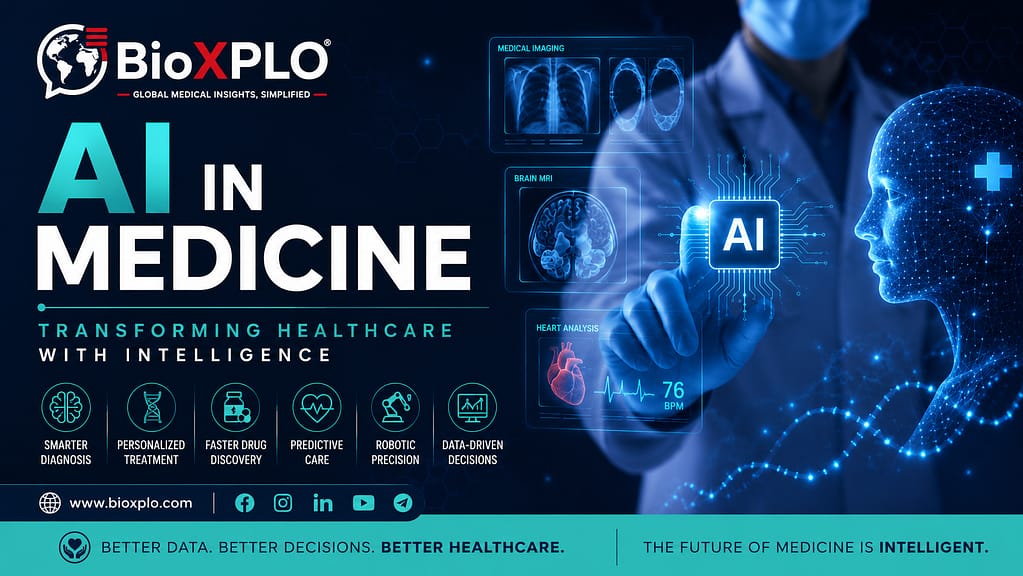
Artificial Intelligence (AI) is no longer a futuristic concept. It has become one of the most transformative technologies in modern healthcare, helping clinicians diagnose diseases earlier, personalize treatments, streamline hospital operations, and accelerate medical research. Rather than replacing healthcare professionals, AI serves as a powerful assistant, enabling faster, more accurate, and data-driven clinical decisions.
What is AI in Healthcare?
Artificial Intelligence in healthcare refers to the use of computer systems capable of analyzing large volumes of medical data, recognizing patterns, learning from experience, and assisting healthcare professionals in making informed decisions. AI technologies include Machine Learning (ML), Deep Learning (DL), Natural Language Processing (NLP), Computer Vision, and Generative AI.
These technologies are now integrated into hospitals, research laboratories, pharmaceutical companies, wearable devices, and telemedicine platforms worldwide.
Key Applications of AI in Medicine
1. Medical Imaging and Diagnostics
AI algorithms can analyze medical images such as X-rays, CT scans, MRI scans, mammograms, retinal images, and pathology slides with remarkable speed and precision. They assist radiologists by identifying abnormalities that may be difficult to detect with the human eye.
Common applications include:
- Detection of cancers
- Stroke identification
- Lung disease screening
- Fracture detection
- Diabetic retinopathy screening
AI acts as a second reviewer, helping reduce diagnostic errors while improving efficiency.
2. Personalized Medicine
Every patient is unique. AI analyzes genetic information, lifestyle factors, laboratory results, and medical history to recommend individualized treatment strategies.
Benefits include:
- Better drug selection
- Reduced adverse effects
- Optimized treatment plans
- Improved patient outcomes
Personalized medicine is especially valuable in oncology, cardiology, and rare genetic disorders.
3. Drug Discovery and Development
Developing a new medicine traditionally takes more than a decade and costs billions of dollars. AI significantly accelerates this process by:
- Identifying potential drug candidates
- Predicting molecular interactions
- Optimizing clinical trial design
- Repurposing existing medications
- Detecting potential side effects early
This enables pharmaceutical companies to develop safer therapies more efficiently.
4. Clinical Decision Support
AI-powered Clinical Decision Support Systems (CDSS) assist healthcare providers by analyzing patient records alongside current clinical guidelines and medical literature.
These systems can:
- Recommend diagnostic tests
- Suggest evidence-based treatments
- Predict disease progression
- Alert clinicians about drug interactions
- Identify high-risk patients
Importantly, AI supports clinical judgment rather than replacing it.
5. Virtual Health Assistants
AI chatbots and virtual assistants improve patient engagement by:
- Answering health-related questions
- Scheduling appointments
- Sending medication reminders
- Monitoring symptoms
- Providing health education
These tools improve healthcare accessibility while reducing the workload on medical staff.
6. Predictive Analytics
Using Electronic Health Records (EHRs) and real-time patient data, AI can identify individuals at risk for future medical complications.
Examples include predicting:
- Sepsis
- Cardiac events
- Hospital readmissions
- Diabetes progression
- Intensive care deterioration
Early intervention often leads to significantly better patient outcomes.
7. Robotic-Assisted Surgery
AI enhances robotic surgical systems by providing greater precision, improved visualization, and enhanced control during complex procedures.
Advantages include:
- Smaller incisions
- Reduced blood loss
- Faster recovery
- Shorter hospital stays
- Increased surgical precision
These technologies are increasingly used in urology, gynecology, cardiothoracic surgery, and general surgery.
AI in Medical Research
Researchers use AI to analyze enormous datasets from:
- Genomic sequencing
- Clinical trials
- Medical imaging
- Biomedical literature
- Public health databases
AI can identify hidden relationships that would otherwise take years to discover, accelerating scientific breakthroughs in disease prevention and treatment.
Benefits of AI in Healthcare
AI offers numerous advantages for patients, clinicians, and healthcare systems:
- Faster diagnosis
- Improved diagnostic accuracy
- Earlier disease detection
- Personalized treatment plans
- Reduced healthcare costs
- Increased operational efficiency
- Better patient monitoring
- Enhanced access to healthcare services
- Support for medical research and innovation
Challenges and Ethical Considerations
Despite its tremendous potential, AI also presents important challenges:
Data Privacy
Healthcare AI relies on large volumes of patient information. Protecting patient confidentiality and ensuring secure data handling remain essential.
Bias in AI Models
AI systems learn from existing datasets. If those datasets are incomplete or biased, AI recommendations may unintentionally produce unequal healthcare outcomes.
Explainability
Healthcare professionals need to understand how AI reaches its conclusions. Transparent and explainable AI builds trust and supports safe clinical decision-making.
Regulatory Compliance
Medical AI systems must undergo rigorous evaluation and comply with healthcare regulations before clinical deployment.
Human Oversight
AI should always function as an assistive technology. Final medical decisions must remain under the responsibility of qualified healthcare professionals.
The Future of AI in Medicine
The coming decade is expected to bring even greater integration of AI into healthcare. Emerging innovations include:
- AI-powered digital twins for personalized treatment simulation
- Advanced wearable health monitoring
- Real-time disease prediction
- AI-assisted robotic surgery
- Precision genomics
- Generative AI for clinical documentation
- Smart hospitals with automated workflows
- Continuous remote patient monitoring
As AI technologies mature, they will become an indispensable component of preventive, predictive, and precision medicine.
Conclusion
Artificial Intelligence is reshaping healthcare by improving diagnosis, supporting clinical decision-making, accelerating research, and enabling personalized patient care. While challenges such as privacy, fairness, and regulatory oversight remain, responsible implementation can unlock extraordinary benefits for both healthcare professionals and patients.
The future of medicine lies not in replacing clinicians with machines, but in empowering healthcare professionals with intelligent tools that enhance accuracy, efficiency, and compassionate patient care.
Author: BioXPLO Editorial Team
Keywords: Artificial Intelligence in Healthcare, AI in Medicine, Medical AI, Machine Learning in Healthcare, Digital Health, Clinical Decision Support, Medical Imaging AI, Healthcare Innovation, Precision Medicine, Future of Healthcare