Introduction
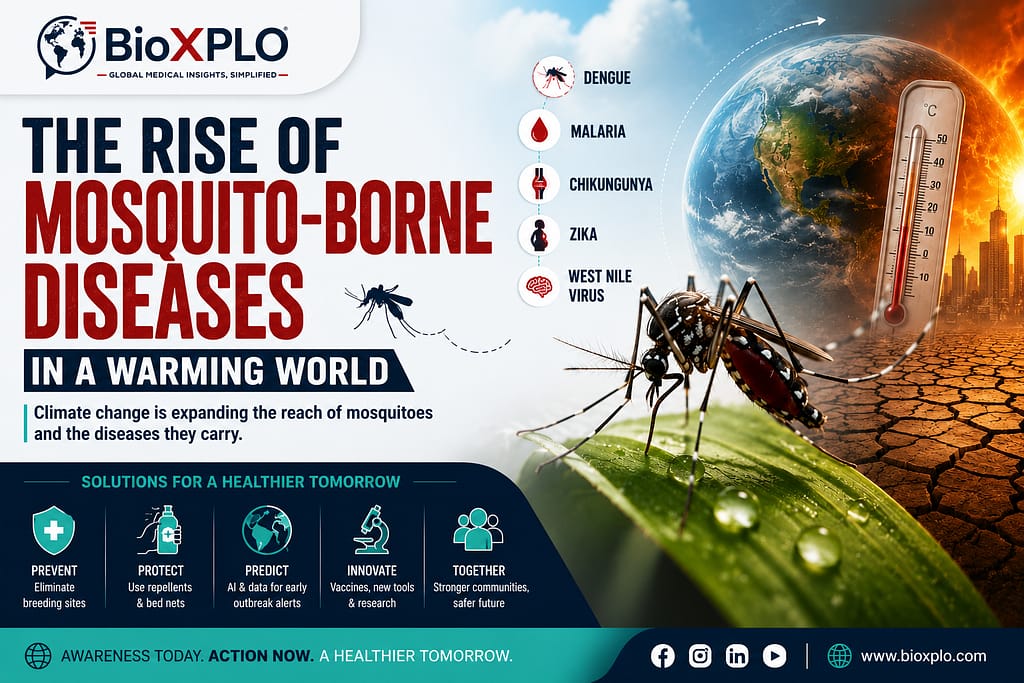
Mosquitoes may be tiny, but they remain the deadliest animals on Earth. Every year, they transmit diseases that affect hundreds of millions of people and cause hundreds of thousands of deaths worldwide. As global temperatures rise, rainfall patterns shift, and urban environments expand, mosquitoes are finding new habitats to thrive. The result is an alarming increase in mosquito-borne diseases in regions that were once considered low risk.
Scientists increasingly recognize climate change as an important driver of this changing landscape, working alongside urbanization, global travel, land-use changes, and socioeconomic factors. Together, these forces are reshaping where mosquitoes live, how long they remain active, and how efficiently they transmit disease.
What Are Mosquito-Borne Diseases?
Mosquito-borne diseases are illnesses transmitted when infected mosquitoes bite humans. Different mosquito species carry different pathogens.
Some of the most important mosquito-borne diseases include:
- Dengue Fever
- Malaria
- Chikungunya
- Zika Virus Disease
- Yellow Fever
- Japanese Encephalitis
- West Nile Virus
These diseases collectively affect hundreds of millions of people every year, placing enormous strain on healthcare systems worldwide. According to the World Health Organization (WHO), vector-borne diseases account for more than 17% of all infectious diseases and are responsible for over 700,000 deaths annually.
Why Is Climate Change Increasing Disease Risk?
Climate change does not create mosquito-borne diseases, but it can make conditions more favorable for mosquitoes and the pathogens they carry.
1. Rising Temperatures
Mosquitoes are cold-blooded insects whose growth, reproduction, and survival depend heavily on temperature.
Warmer conditions can:
- Accelerate mosquito development.
- Increase biting frequency.
- Shorten the time viruses and parasites need to become infectious inside mosquitoes.
- Extend the mosquito breeding season.
However, the relationship is complex. Extremely high temperatures can also reduce mosquito survival in some regions, which is why local conditions matter.
2. Changing Rainfall Patterns
Mosquitoes breed in standing water.
Climate change influences rainfall through:
- Heavy rainfall creating temporary breeding sites.
- Flooding leaving stagnant water behind.
- Drought prompting water storage in containers, which can become breeding habitats for Aedes mosquitoes.
Both excessive rainfall and water storage practices can increase mosquito populations under different circumstances.
3. Higher Humidity
Mosquitoes survive longer in humid environments.
Longer mosquito lifespans increase the likelihood that they will live long enough to transmit viruses or parasites after becoming infected.
4. Expansion Into New Regions
One of the most concerning trends is the expansion of mosquito habitats into:
- Higher altitudes
- Temperate regions
- Previously cooler climates
WHO reports that warming temperatures are contributing to the expansion of mosquito vectors into new geographic areas, although climate is only one of several factors involved.
Diseases on the Rise
Dengue Fever
Dengue has become one of the fastest-growing mosquito-borne diseases globally.
More than 3.9 billion people are estimated to live in areas at risk. Recent years have seen major increases in dengue transmission, with climate change, urbanization, and expanding mosquito populations contributing to outbreaks alongside limitations in surveillance and public health infrastructure.
India has also seen a sharp increase in dengue cases over the past two decades, and in 2026 the country’s first approved dengue vaccine, Qdenga, received regulatory approval, marking an important milestone in disease prevention.
Malaria
Malaria remains one of the world’s deadliest infectious diseases.
WHO estimates approximately:
- 249 million malaria cases annually
- More than 608,000 deaths each year
Most deaths occur among children under five years of age in sub-Saharan Africa. Climate change may shift malaria transmission into some higher-altitude or previously cooler regions, while some very hot areas could become less suitable, highlighting the complexity of climate impacts.
Chikungunya
Chikungunya causes:
- High fever
- Severe joint pain
- Muscle aches
- Fatigue
The disease has expanded geographically over recent decades as Aedes mosquitoes spread into new environments.
Zika Virus
Although global outbreaks have declined since 2016, Zika remains a major concern because infection during pregnancy can cause serious birth defects, including congenital Zika syndrome.
West Nile Virus
West Nile virus continues to emerge in new regions and can occasionally cause severe neurological disease, particularly in older adults and immunocompromised individuals.
Beyond Climate: Other Drivers of Spread
Climate change is only part of the story.
Other important contributors include:
- Rapid urbanization
- Poor waste management
- Standing water around homes
- International travel
- Global trade
- Population growth
- Weak vector surveillance
- Limited public health infrastructure
Experts emphasize that the spread of mosquito-borne diseases results from the interaction of environmental, social, and demographic factors rather than climate alone.
The Public Health Impact
Increasing mosquito-borne diseases can lead to:
- Overcrowded hospitals
- Increased healthcare costs
- School absenteeism
- Reduced workforce productivity
- Greater pressure on public health systems
- Higher mortality among vulnerable populations
Low- and middle-income countries often bear the greatest burden because they have fewer resources for surveillance, prevention, and treatment.
Innovative Solutions
Scientists and public health agencies are developing new strategies to reduce mosquito-borne diseases.
Vaccines
Vaccination is becoming an increasingly important tool for diseases such as dengue in eligible populations, although vaccines are only one component of prevention.
Wolbachia Mosquitoes
Researchers are releasing mosquitoes infected with Wolbachia bacteria.
These bacteria reduce the mosquitoes’ ability to transmit viruses like dengue, chikungunya, and Zika. Programs in countries such as Brazil have shown encouraging results as part of integrated vector control efforts.
Artificial Intelligence
AI is improving:
- Outbreak prediction
- Climate-based risk mapping
- Mosquito surveillance
- Early warning systems
- Resource allocation
By combining weather data, satellite imagery, and epidemiological information, AI can help health authorities anticipate outbreaks and target interventions more effectively.
Genomic Surveillance
Modern sequencing technologies help scientists:
- Track viral evolution.
- Detect new variants.
- Monitor mosquito populations.
- Improve outbreak response.
How Can Individuals Protect Themselves?
Simple preventive measures remain highly effective.
- Remove standing water around homes.
- Use mosquito repellents.
- Wear long-sleeved clothing.
- Install window screens.
- Sleep under insecticide-treated bed nets where recommended.
- Follow local public health guidance.
- Seek medical care promptly if symptoms develop after mosquito exposure.
Community participation is essential because reducing mosquito breeding sites benefits everyone.
The Future of Mosquito-Borne Diseases
Without stronger action on climate adaptation, vector surveillance, urban planning, and public health preparedness, mosquito-borne diseases are expected to remain a growing challenge.
However, advances in vaccines, AI-powered forecasting, improved diagnostics, integrated mosquito control, and international collaboration provide reasons for optimism.
Protecting communities will require a combination of scientific innovation, environmental management, resilient healthcare systems, and public awareness.
Conclusion
Mosquito-borne diseases are no longer confined to traditional tropical hotspots. A warming climate, changing ecosystems, urbanization, and global connectivity are together reshaping the global distribution of mosquitoes and the diseases they transmit.
Understanding these interconnected drivers is essential for developing effective prevention strategies. While climate change is an important piece of the puzzle, sustainable public health measures, stronger surveillance, scientific research, and community engagement will ultimately determine how successfully the world responds to this growing challenge.
Frequently Asked Questions (FAQ)
Are mosquitoes becoming more dangerous because of climate change?
Climate change can increase the risk of mosquito-borne disease in many regions by altering temperature, rainfall, humidity, and mosquito activity. However, disease spread also depends on urbanization, travel, land use, healthcare infrastructure, and public health interventions.
Which mosquito-borne disease is spreading the fastest?
Dengue has shown one of the most rapid global increases in recent decades, with large outbreaks reported across many regions.
Can mosquito-borne diseases be prevented?
Yes. Prevention includes mosquito control, eliminating breeding sites, using repellents, protective clothing, bed nets where appropriate, vaccination for eligible diseases and populations, and timely public health surveillance.
Does every mosquito carry disease?
No. Only certain mosquito species carry specific pathogens, and not every mosquito of those species is infected.
References
- World Health Organization. Vector-borne diseases.
- World Health Organization. Dengue upsurge (2023 to present).
- World Health Organization. Climate change and health.
- World Health Organization. Climate change, neglected tropical diseases and malaria.
- Systematic review of climate-driven mosquito range shifts.